So far this is my favourite picture of all the pictures that I have taken in Mexico. For me this statue has become quite the icon and symbolizes to me that Santa Muerte is not just found in the prescribed holy places, in chapels and churches. She resides on the streets, with us, while we live our lives. Death walks hand in hand with us as always present, and we never know when it will be our turn to meet her face to face in the ultimate life transition. This is also the same Santa Muerte statue that we see on the front cover of the first edition of Andrew Chesnut’s book “Devoted to Death”, one of the few Santa Muerte books written in English. I find it curious that while writing about the history of Santa Muerte, Andrew himself became part of that history as I believe that his book has contributed towards the increasing understanding of her in the English speaking world.
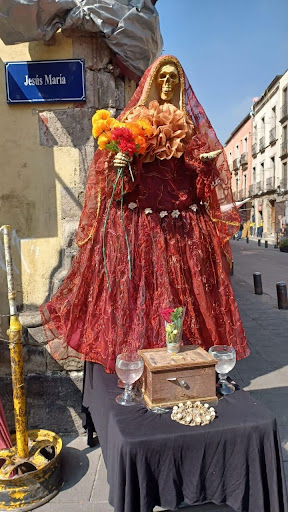
I did not see this shrine on my first visit to Mexico City in 2023; I was only in the city for a few days before continuing my travels south so I was determined to see her on my second visit. I’ve seen so many photos of this shrine where Santa Muerte is dressed in different dresses, clearly she is well looked after. The shrine can be found not far from the Zolcalo in the city center -, one walks down Calle Moneda, keep going and the road becomes Calle Emiliano Zapata, keep going, and you will see her when the road intersects with Calle Jesus Maria. It should only take 10 minutes. Took me a bit longer as for some unknown reason police were not letting people down Calle Moneda that morning and I had to go a roundabout way to reach Calle Jesus Maria. They were letting people walk to the Zolcalo from Calle Moneda but not the other way around and the police were directing to different side streets. The perils of travelling without knowing the language- you have no idea what’s going on half the time. Eventually I get to Jesus Maria and start walking up the street in the direction to Emiliano Zapata. I initially see her at a distance, my speed of walking increases. I can’t quite say that I ran to her as I don’t do running but let’s say that I walked at my briskest pace.
While travelling in 2023, each time I encountered a Santa Muerte shrine I had this tendency to burst into tears. This time it was a different experience as I felt an overwhelming sensation of ecstatic joy each time I encountered her in Mexico City in 2025. Having spent some time at the shrine speaking with her and taking copious amounts of photos I was very reluctant to leave but I needed to make my way to Sonora Mercado for some serious occult retail. So I said my goodbyes but it was not a goodbye for long. Fortunately, my pathways took me in the vicinity of Calle Jesus Maria on a few more occasions during my stay so I was able to spend time at this shrine more than once.
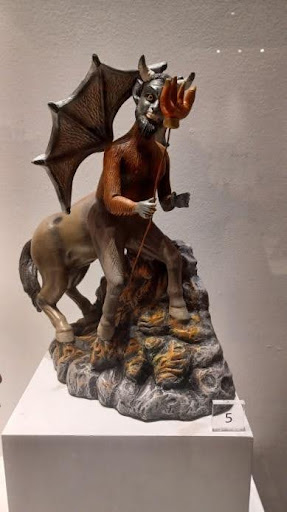
I was in Mexico City for the Day of the Dead and the backdrop to this visit was the discouragement by the Catholic Church of integrating Santa Muerte into the Day of the Dead activities. As the Saint of Death it’s natural to see the Day of the Dead as an ideal time for working with Santa Muerte, much to the dismay of those that oppose her worship. Santa Muerte is not liked by everyone in Mexico, some seeing her as blasphemous, some seeing her worship as devil worship and using her popularity within organized crime as proof of this. The accusation of devil worship is given some traction by how common it is to see Santa Muerte icons alongside icons of the Dark Angel or of Baphomet. However, these images are given different meanings by their worshippers than the meaning that is ascribed to them by their opponents, the devotees to Satan viewing them as beneficial and the mainstream Catholics viewing them as bad. It seems that Satanism is becoming increasingly popular in Mexico as when I was wandering around in 2025 I saw more icons of Satan than were present during my wanderings in 2023.
Due to Santa Muerte’s non-judgmental acceptance it’s not surprising for people who feel that they cannot approach the traditional Catholic Church to approach her which includes people involved in criminal activities. This does not mean that Santa Muerte causes crime; poverty and desperation along with lack of choice and opportunity causes crime. Plus, Santa Muerte worship does not equal criminal activity as many people such as myself work with her who have no links to organized crime.
To the authorities however, I would be seen as engaging with Satanism and would be treated with a measure of disdain and suspicion. I needed to change planes in Fort Worth on route to Mexico but was glad I had a straight through plane on my return. I would not want to be taking any Santa Muerte statues across the USA border as I know if they were discovered I would immediately be under suspicion of being involved in criminal activities, which is the measure of discrimination towards Santa Muerte followers. On my first visit to Mexico where I travelled back to London from Cancun I saw on my return that some of my Santa Muerte statues had been suspiciously broken from the foot of the statue which to me looks like they were being searched for substances.
I too have a Santa Muerte shrine which includes a statue of a figure that could be interpreted as Satan. I call that statue Baphomet so it may or may not have a different meaning for me than it would have for a person living in Mexico. I did find myself wondering as I was strolling around Mexico City whether there was any connection between the Satan figures that I was seeing within Mexican folk art and devotion to Satan. I also mused upon how pagan deities in Europe became devils in the eyes of the rising Christianisation in the early parts of the Common Era and whether something similar had occurred in Mexico due to colonization? The building of churches on pre-Christian sacred sites and condemnation of the pre-Christian faiths was definitely a thing on both sides of the Atlantic. This leads to my asking the question, when I see a Satan figure in Mexico am I looking at a pre-Christian deity? These are all questions that I cannot answer as I currently know very little about how Mexican devotees interpret and experience the icons of Satan/ Baphomet. So I can only discuss how I interpret the images.
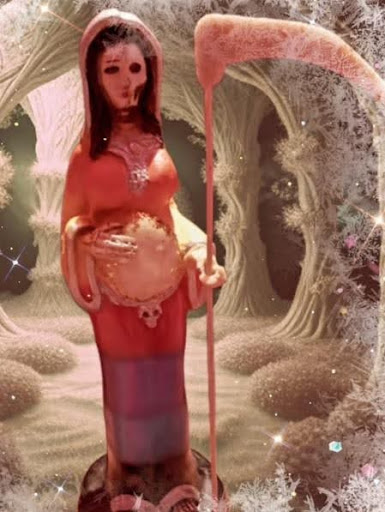
One of the images of Santa Muerte which I find most interesting is the mash up with her and The Virgin of Guadalupe into a half saint death and half saint life icon that merges the two deities into a single entity. She is often referred to as GuadaMuerte. She has been the subject of much condemnation, being seen as particularly blasphemous. Her popularity is reflected by the fact of my seeing her icon in every botanica that I went into during my recent visit to Mexico City.
A Catholic friend of mine says that putting the Virgin of Guadalupe and Santa Muerte together is theologically incorrect but I am not viewing her in the context of those beliefs; I am viewing her through the cultural lens of chaos magick. Therefore, I see something else entirely and that something can aid us in seeing through the illusion of duality and by that realizing an enlightened state of consciousness.
This clearly illustrates how belief impacts on the perception and interpretation of the world around us and in the significance of religious understanding in gaining comprehension of people’s behaviours and motivations. To understand a culture you need to understand their faith. A Mexican person working with GuadaMuerte in Mexico may see something else again and could disagree with me completely. I am very conscious of the practice of white Europeans interpreting another culture in the context of their own and thus misunderstanding the culture.
So I recognize that I work with GuadaMuerte in the way that a white European Chaos Magician would work with her which may not have any relevance to how she is perceived in Mexico. Differing opinions is something that I generally view as a good thing, but problems arise when one group seeks to impose their beliefs on another group which to my understanding is what is occurring with the widespread condemnation of Santa Muerte, which I view as a form of spiritual abuse.
I am drawn to the image of GuadaMuerte as I am a member of the chaos magick group “The Illuminates of Thanateros” (IOT), Thanatos being one of the Greek gods of death and Eros being the Greek god of life or of the things we do to create life. Putting them together in the single entity of Thanateros is bringing together life and death, viewing life and death as one and the same and not polar opposites. The word “illuminates” added to that means that we can be interpreted as an occult order that seeks illumination via a non-dualistic understanding or a realization that death and life are not separate but on the same continuum. I assume that the reason why the founders of the IOT chose the life and death duality is because these are universal; all that lives will die and all that die must have lived first.
Sometimes people say that there is no illumination magick in chaos magick. That chaos magick is all about getting your material needs met, and as it happens, yes it is an effective approach to this. If you want to get rich, laid and even then chaos magick can do this for you, if that’s all you want to do, but illumination magick is there if you know how to look for it. Chaos mysticism is a thing.
For me the enlightenment magick within chaos magick is as clear as day. Many of the techniques that chaos magick is known for are all paths to illumination one of these being the concept of the Neither: Neither. Austin Osman Spare, who was a huge influence on the creation of chaos magick discussed the Neither: Neither, which was later taken up by Peter Carroll, one of chaos magick’s founders. The Neither: Neither is a space between dualities and by entering into this space one can discover the realization of one’s connection to the source of all creation which I call chaos.
The Neither: Neither is the crossroads that leads into the realms of chaos where all things collide and there is no separation between phenomena. This space can be represented by the chaos star symbol which can be viewed as a crossroads where all dualities converge into a single space. As the divisions begin to diminish in our minds the portals of chaos opens. When that occurs, we can either descend into madness or we become magicians. This is the Cauldron of Ceridwen where all dualities converge.
Neither: Neither is a similar concept to the Sanskrit phrase Neti: Neti, which means “not this not that” used to describe the nature of Brahman. Used as a mediation or mantra, Neti: Neti can assist us to attain the realization that we are not the things that we often use to create our identity. We are beyond our everyday identity, beyond dualism. Another approach can be instead of the negation in Neti: Neti is to use the affirmation “I am this I am that”, via the phrase “Tat Tvam Asi”. This can build up the realization that we are not separate from that which surrounds us.
Chaos magick is a nebulous concept that’s often difficult to define; by its very nature magicians are encouraged to find their own pathways to the divine as opposed to seeking refuge in the teachings of others. Therefore reaching an all-encompassing definition is impossible because as soon as one defines something you have pinned it down. Boxing chaos magick within a single definition means that it cannot be anything outside that box, so by defining we will have immediately narrowed our range of experiences within chaos magick. For this reason a chaos magician will work with a paradigm or working definition/ hypothesis to assist with their overall goals and then discard that definition when it is no longer useful.
These days my current hypothesis on chaos magick is that it is “the practice of engaging with the creative and destructive forces in the universe to achieve unity within the source of the multiverse that I call chaos.” These creative forces can be represented by Guadalupe, i.e. life and the destructive forces i.e. death by Santa Muerte. GuadaMuerte can take us into the spaces between life and death, to the Neither: Neither where one can realize the nature of life and death not as a polarity but as an holistic phenomenon.
This of course does not mean that I view Santa Muerte as wholly about death as she has assisted me with a number of creative tasks and it does not mean that Guadalupe cannot assist with bringing issues to a close or an end. Both goddesses can do both illustrating that they are not really goddesses that focus on one to the detriment of the other, but Guadalupe is more closely associated with life and Santa Muerte is more closely associated with death in the minds of people who encounter them.
My current thinking on chaos magick takes the words from the beginning of Hesiod’s Theogony from Greek mythology, “in the beginning was chaos” and all of the gods and goddesses and everything that we perceive around us today comes from that chaos force. I am working with the idea that chaos is the monad within what is essentially a Neo-Platonic world view. In this view all things that exist come from the one source and within this source there are no differentiations between phenomena as all things are one thing. Another way of describing this is that chaos is the point of singularity that preceded the big bang.
As chaos expands outwards from the source it expands in increasing diversification which is why the Titans in Greek mythology, that precede the Olympians, are often composite entities as they are closer to the source of chaos. As we move further away from chaos via evolution, entities increase in their separation so become single entity creatures whereas creatures closer to chaos are composite often containing opposite qualities within the same entity. This would mean that life and death are the same having been born out of the same non dualistic source and one can work with GuadaMuerte to assist one in overcoming the illusion of separateness and uniting with the chaotic source of creation.
This concept is seen within many spiritual paths and the idea of the unity of the dualities of life and death can be found within Mexican mythology. For example, in the dual god Ometeotl who lives at Omeyocan meaning the “place of duality”. While there are some debates as to whether Ometeotl is a deity of yore and yesteryear or a more modern manifestation, their presence within Mexico illustrates to me that the concept of dual deities exists within Mexican thinking and therefore it should not be surprising that Guadalupe as the goddess of life would be merged with Santa Muerte as the goddess of death within the single figure of GuadaMuerte.
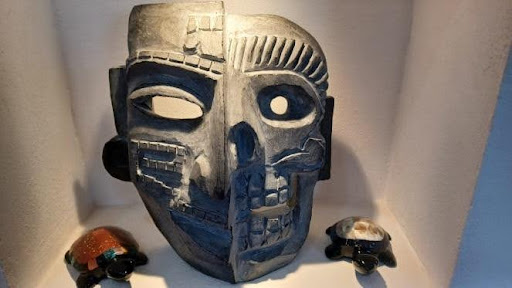
I saw the merging of dualities during the Day of the Dead parade where many people dressing up as Catrina’s only had one side of their face painted in skeletal form, I saw it in the life and death masks depicted in a store near Teotihuacán, I saw it in the celebratory nature of the day of the Dead which intermingles grief and joy. Life and Death walk hand in hand and are different aspects of the same phenomena.
I also see this merging of duality within images of the Angel of Light and the Dark Angel. Images of Satan in Mexico are not all the same; there are many different depictions. For me however, when I see an image of Satan which is clearly Satan and not Baphomet I see a representation of the concept of matter over spirit, when I see an Angel of Light I see the concept of spirit over matter. In Levi’s Baphomet these two concepts plus other dualities are merged into one meaning that matter is spirit and spirit is matter with no divisions between the two so neither one has more value than the other. Baphomet for me represents the sum total of all that exists and is therefore the ultimate creature of chaos that merges all dualities. Baphomet is male and female, human and animal, light and dark and their horn of light represents the illumination that comes with knowledge achieved beyond the realm of duality.
There is a history of humans subscribing everything to Satan that we do not like about ourselves, which has assisted us in being able to repress those sides of us that we are not able to accept. Carl Jung felt that in order for a person to become fully themselves they needed to undertake what he called the process of individualisation, to integrate the shadow sides of ourselves in order for us to become whole. These shadow sides are not necessarily bad or negative, sometimes they can be a force of good but we reject them for all sorts of reasons. Baphomet for me represents the fully individualised self, the person who has fully integrated their selves and their dual nature.
When I look at GuadaMuerte I feel something similar to that, a representation of the ability to integrate what is known and loved in humanity and that which we suppress into a fully individuated mode of being.
Both GuadaMuerte and Baphomet carry with them the idea that dualities are different sides of the same coin. Baphomet, Santa Muerte, Guadruple and GuadaMuerte can assist the seeker in working towards a non-dual realization. Santa Muerte teaches us that spiritual enlightenment is not some lofty goal that can only be achieved by removing oneself from the distractions of the world, as spirituality and the everyday are not that separate from each other. Like the quality of life and death, the material and the spiritual walk hand in hand. Enlightenment can be found in the mundane, in the everyday, and on a street corner at Calle Jesus Maria in downtown Mexico City.
By guest contributor Soror Brigantia 739 who has practiced magick for 39 years and has been a member of the Illuminates of Thanateros for 21 years. She is a past Section Head of the British Isles Section and currently holds the position of Section Sponsor. Soror Brigantia has been working with Santa Muerte since 2017 following visitations during her dreams. Check out her Illuminates of Thanateros and Chaos Mandala.

 Most Holy Death