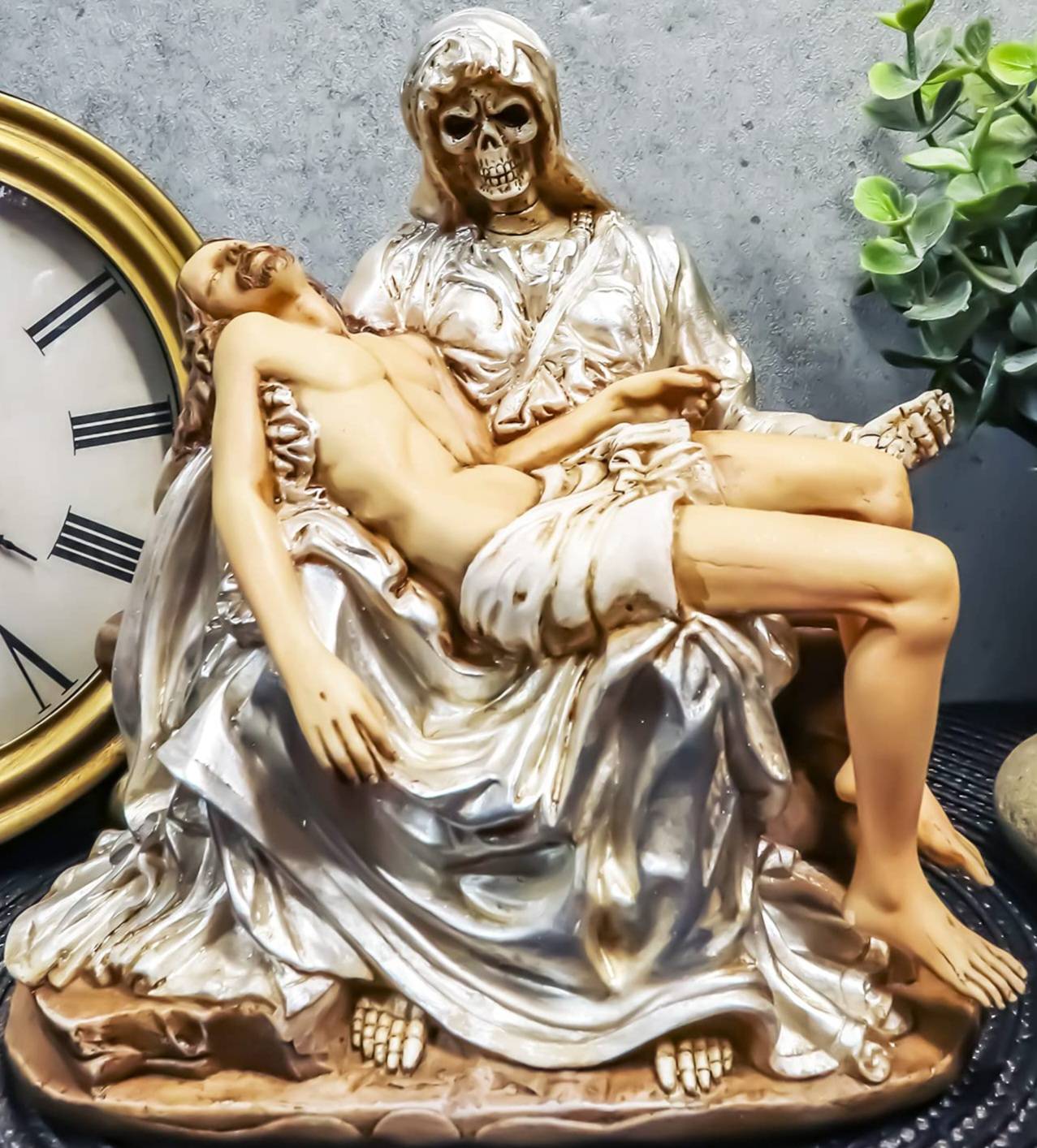
The Roman Catholic Church declares that those who are devoted to Santa Muerte cannot be followers of Jesus, as He conquered death on the cross, which factually is not correct.
Jesus died on the cross fully experiencing the mortality we humans know and embraced our Bony Mother when He left his mortal coil. There was no need for Him to conquer death, for Jesus knew it is a way to the divine, just as the Lord did. We all will ultimately leave our fleshly body behind and enter a whole other world, that of the spirit.
If Jesus would have overcome death on the cross, he would not have died, but as we find in the New Testament: Hebrews 2:9-10 “But we do see Jesus, who was made lower than the angels for a little while, now crowned with glory and honor because he suffered death, so that by the grace of God he might taste death for everyone. In bringing many sons and daughters to glory, it was fitting that God, for whom and through whom everything exists, should make the pioneer of their salvation perfect through what he suffered.”
By leaving His mortal coil behind He was guided by the Skinny Lady Herself, and descended into Sjeol (Limbo) to bring the message of comfort and liberation to all the souls who had died before Him. This is also stated in the creed of the RCC, and we find confirmation of this in the Gospel of Nicodemus (non-canonical text), where it details Jesus’s descent into Hades, liberating the righteous who died before his crucifixion.
Jesus then was guided to the tomb by La Flaquita, where His body was and was resurrected on the third day. It is at that moment that his mortal physical body was transformed into an energetic immortal one, just as is promised to all those who follow in His footsteps. Through death we will find new life. Death isn’t conquered, but embraced, so we also can be gifted the new and everlasting life. We can find a comparison to this point in the non-canonical gospel of Mary Magdalene where Jesus emphasizes spiritual transformation and (inner) resurrection.
When Jesus resurrected and his mortal body was transformed into an immortal one, a strong energy radiated from Him outward, and as such He told the women who saw Him after the resurrection not to touch Him, for most likely they would have succumbed, just as in the Old Testament only the Jewish High Priest was allowed to come before of the Ark of the Covenant, as no one else could handle the power emanating from the Ark. See also John 20:17 “Jesus said, “Do not hold on to me, for I have not yet ascended to the Father. Go instead to my brothers and tell them, ‘I am ascending to my Father and your Father.” and 2 Samuel 6:6-7 “When they came to the threshing floor of Nakon, Uzzah reached out and took hold of the ark of God, because the oxen stumbled. The Lord’s anger burned against Uzzah because of his irreverent act; therefore God struck him down, and he died there beside the ark of God.”
The promise of Jesus, that we all can live forever, and the veneration of Santa Muerte can go hand in hand. Believing in Santa Muerte and praying to Her doesn’t mean that we no longer believe in the promise of Jesus, or what he taught us, but that seeking guidance and protection from Santa Muerte doesn’t negate faith in Jesus but rather seeks additional spiritual support for guidance in life and the afterlife.
Conclusion:
The belief that the Catholic Church holds, that devotion to Santa Muerte is opposite to Jesus’s death on the cross, overlooks the deeper essence of Jesus’s journey. His embrace of mortality, experiencing death just as we do, was not a conquest but a transformative passage. Jesus, in His mortal coil, fully encountered the human experience, acknowledging the inevitability of passing from flesh to spirit, a transformation from mortal to immortal.
Contrary to the notion of overcoming death, Jesus, through His crucifixion and subsequent descent, revealed a profound truth: death is not a foe to be conquered but a transition to embrace. In essence, devotion to Santa Muerte and the teachings of Jesus need not be seen as conflicting paths. Rather, they intertwine to offer a deeper understanding of mortality, resurrection, and the journey from flesh to spirit, enriching one’s spiritual quest for enlightenment and eternal life.
By guest contributor Walter M.C. Walgraeve who is a devotee of Santa Muerte and a Traditional Catholic Bishop (Emeritus). Follow him on Twitter.

 Most Holy Death