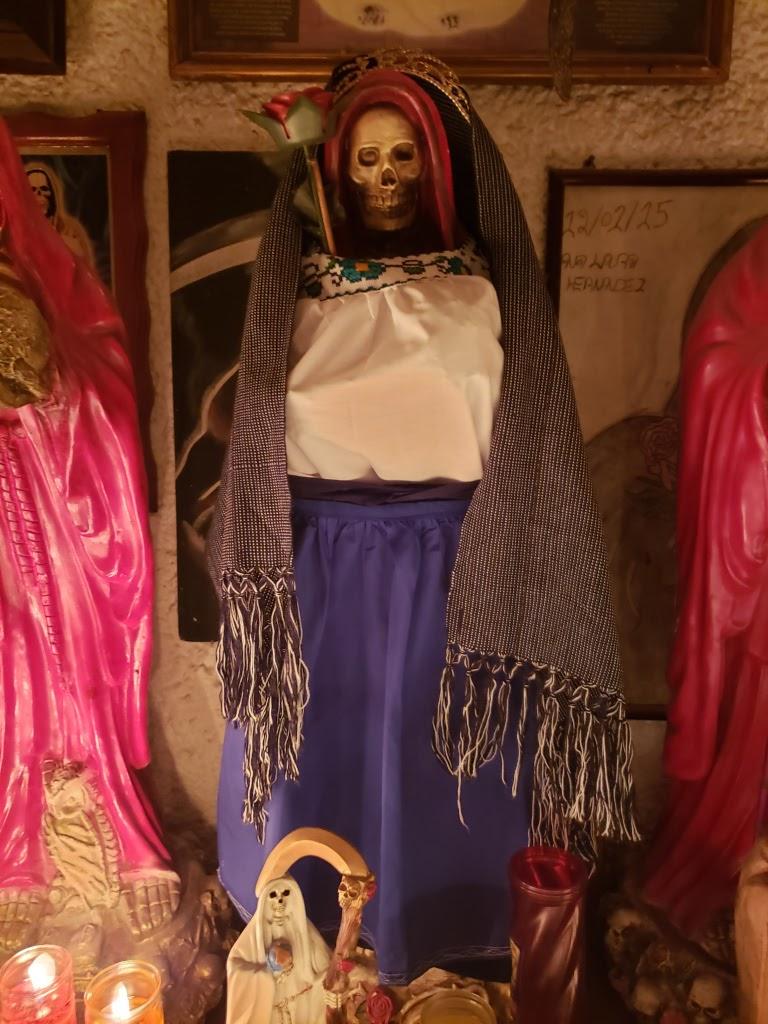
By guest contributor Dr. Strega Cerbone-Colangelo*
Death comes for us all, for some as a shadow waiting to snatch our souls, for others, as an angel that comes down from heaven to carry us home. In every culture across the globe there is some reference or myth about death personified. The image of death is represented as a Grim Reaper, a keeper of the underworld, a faceless phantom, and in Mexico, it’s Santa Muerte.
Santa Muerte’s first documented appearance as a venerated figure in Mexico occurred in a 1793 Inquisition report on idolatrous practices by Indigenous worshipers. However, Indigenous tribes in what is now the US and Canada also venerated the female representation of death, knowing it was an end to life on Earth but believing it to be the start of a new life in the Spirit World. Each Indigenous tribe has its own language and therefore Santa Muerte has close to 100 various names attributed to her.
Most tribes also believed that the journey might be long, so afterlife rituals were performed to ensure that the spirits would not continue to roam the earth. Various tribes honored the dead by giving them food, herbs, and gifts to ensure a safe journey to the afterlife. Devotees of Santa Muerte also place offerings such as apples, cigars, and candles on her altars. Practitioners across North America employ magical rituals derived from Indigenous practices, as well as elements of Spiritualism and ideas about spiritual energy.
The Hopi believe that the soul moves along a Sky path westwards and that those who have lived a righteous life will travel with ease. However, those who haven’t will encounter suffering on their journey. To ensure a safe journey, they wash the bodies of their dead with natural yucca suds and dress them in traditional clothes. Prayer feathers are often tied around the forehead of the deceased, and they are buried with favorite possessions and feathered prayer sticks. Traditional foods and special herbs are served and placed graveside.
The Navajo perceived that living to old age was a sign of a life well-lived, thus ensuring that the soul would be born again. Alternatively, they felt that if a tribe member died of sudden illness, suicide, or violence, a “Chindi,” or destructive ghost, could cause trouble for the deceased’s family. Afterlife rituals could last for several days with careful thought given to foods and herbs chosen for the celebration, reflecting how the deceased lived their life. Common herbs used by the Navajo included Broom SnakeWeed, Soap Weed, and Utah Juniper. Many believe that the spirits return to visit family and friends on that day. In preparation, various tribes would prepare food and decorate their homes with ears of corn as blessings for the dead.
I, myself, am half Kanien’kéha and a member of the Haudenosaunee Confederacy, which includes 6 tribal nations. For those who are unfamiliar, the Haudenosaunee, or “people of the longhouse,” commonly referred to as Six Nations, are members of a confederacy of Aboriginal nations inhabiting the northern part of New York state and Canada. We consist of the Seneca, Cayuga, Oneida, Onondaga, and Mohawk. When the Tuscarora joined the confederacy early in the 18th century, it became known as the Six Nations.
According to Haudenosaunee beliefs, when a person dies, their breath of life is taken by the Faceless One, the destroyer who brings death. However, the spirit of the individual takes several days to get used to the death of the body and prepare to take its journey skyward. The Faceless One shares strikingly similar iconography with Santa Muerte.
Today, there are more than 6.5 million Native Americans in the U.S. who make up 574 tribal nations and villages. Each tribe is different and has its own rich history and death culture. In some tribes death rituals include painting the faces of the dead red, the color of life. Others wash the body of the deceased with yucca before burial. Sometimes, feathers are tied around the head of the deceased as a form of prayer. Some families dress the deceased in full regalia and jewelry, with moccasins for their trip to the next world.
One common thread is that death is considered a natural part of the cycle of life, and customs for the dead in the Native American community typically prepare the soul for the spiritual journey or for the spirit to “walk on.” While these tribal nations unite in this understanding, one main difference is whether the tribe fears or accepts death, which dictates how they prepare the deceased for their spiritual journey.
Also many tribes see the deceased as ever-present ancestral spirits who sometimes lend aid. The Sioux don’t fear the soul of the deceased, but rather reach out to spirits in times of need and communicate with them. Similarly, the Lakota do not have a fear of death or of going to the underworld. They do believe in a spirit world specifically, but Hihankara (who manifests similarly to Santa Muerte) relieves the deceased of pain and suffering. For tribal nations that view death in this way, moving from this world to the next is not something to be mourned, but rather is be celebrated.
Similarly, Indigenous Hawaiians have a diverse culture that is expressed in many facets of their society. This richness in culture extends even to their funerals. Indigenous Hawaiians believe in and worship an array of gods, and where a person’s soul goes after death depends on the specific god they worshiped while alive. For instance, if they believed in the sun god, they would go in the direction of the sun, and so on. However, not all souls get to depart this earth. Some end up as wandering souls, also called paper, which is the living fear. Some spirits also become unihipili, or household gods, protecting the members of a household. Even at present, many Hawaiians still believe in the native gods. Many believe that a person’s iwi, which is a person’s spiritual essence that remains in the bones, lives on even after death.
Grief is often expressed at these services through singing and dancing. The hula is one such dance that is traditionally performed at funerals and is usually performed by the family members of the deceased. Praying to one’s gods and ancestors remains a common practice. The prayers themselves are often symbolic and are usually performed or chanted in the form of a song to encourage the spirit of the deceased to depart from the body. Aside from prayers, food is also sent to the spirit; people do this in the belief that it will make the spirits of their loved ones happy.
In Hawaiian culture bones are seen as a significant part of the body because they contain a person’s mana or spiritual essence. Native Hawaiians would often bury their dead in secret caves, and the bones were then washed carefully, wrapped, and then buried. Another option is to scatter the ashes at sea while chanting.
Indigenous Hawaiians believe in Hine-nui-te-pō, also known as the “Great Woman of Night,” a giant goddess of death and the underworld. Kanaloa is similarly viewed as the God of Evil, Death, and the Underworld. While Hine-nui-te-pō iconography is very different from that of the hisoricall Santa Muerte, it should be noted that she carries a skull in one hand and either a blood-tinged spear or scythe in the other.
In West Africa, Oya is an Orisha (goddess) whose name means “She tore” with much of her power rooted in the natural world. She is the goddess of thunder, lightning, tornadoes, winds, rain, storms, and hurricanes. As a fire goddess, it is Oya who brings rapid change and aids us in both inner and outer transformation. She is feared by many people because she brings about sudden structural change in people and things.
Similar to Santa Muerte, Oya is also the guardian of the realm between life and death. As such, she is the goddess of spirit communication, death, funerals, psychic abilities, intuition, rebirth, and cemeteries. When women find themselves in hard-to-resolve conflicts, she is the one to call on for protection. Women relate to Oya because she was a great warrior, courageous, and fearless in life.
Ala rules over the underworld and holds the deceased ancestors in her womb. Ala is a goddess of the Ibo, the people of eastern Nigeria. Her name translates “to ground” in the Igbo language, denoting her powers over the earth and her status as the ground itself. The daughter of the great god Chuku, she is the mother goddess of the earth and mother of all, ruler of the underworld and cycles, guardian of the harvest, and goddess of fertility for both people and animals.
According to Ibo beliefs, Ala makes a child grow within their mother’s womb. She remains near and watches over the child as they grow into an adult. Later when the individual dies, Ala receives them into her womb, known as the pocket of Ala. The goddess is also a lawgiver who shows people how to live a good life. Her laws emphasize moral values such as honesty.
Isis/Nephthys, the highly influential Egyptian goddess, shares a striking kinship with Santisima Muerte. She was associated with mourning, the night/darkness, childbirth, the dead, protection, magic, health, and embalming. The origins of Isis are obscure. Unlike many gods, she can’t be tied to a specific town, and there are no definite references to her in the earliest Egyptian literature. Over time she grew in importance, though, eventually becoming the most important goddess in the pantheon. As the devoted wife who resurrected Osiris after his murder and raised their son, Horus, Isis embodied the traditional Egyptian virtues of wife and mother.
As the wife of the god of the underworld, Isis was also one of the main deities concerned with rites for the dead. Along with her sister Nephthys, Isis acted as a divine mourner, and her maternal care was often depicted as extending to the dead in the underworld. Isis was one of the last of the ancient Egyptian gods to still be worshipped. In the Greco-Roman period she was identified with the Greek goddess Aphrodite and her cult spread as far west as Great Britain and as far east as Afghanistan. It is believed that depictions of Isis with the infant Horus influenced Christian imagery of Mary with the infant Jesus.
In conclusion, for those Christians who are staunchly opposed to individuals who pray to Santa Muerte and hold her close to their hearts, know that her presence brings the same peace as the “blessings” that you claim. Santa Muerte delivers, as did saints and death goddesses before her. She is known as “La Niña Blanca,” “The White Girl,” “La Flaquita,” or “The Skinny One,” but she is best known as “la Santa Muerte” or “Holy Death,” a controversial deity or “saint” who leads the fastest growing New Religious Movement on the planet.
Santa Muerte is a controversial figure due to the perceived notion that she is the patron saint of thieves, drug dealers, kidnappers, and other criminals. How though is she any different than, for example, San Giuliano L’Ospitaliere, the patron saint of remote Accettura, which lies in the rugged southern Italian hinterland of Matera, a province in the region of Basilicata, also called Lucanio? He happens to be the patron saint of my maternal familial lineage. His patronage includes innkeepers, murderers, gamblers, wandering criminals, and kidnappers. The difference is that San Giuliano L’Ospitaliere was canonized while Santa Muerte strikes fear into the hearts of the Catholic establishment. In reality, Santa Muerte devotion is similar to other aspects of folk Catholicism, except it’s more open to a wider variety of non-Catholic influences.
*Dr. Strega Cerbone-Colangelo
RNBC-ANCC
MFA-Creative Arts, MFA- Renaissance and Baroque periods.
M.Phil Fine Arts, Art History, and Studio Practicum at Columbia University.

 Most Holy Death
Articolo molto interessante e dettagliato grazie
LikeLike