Co-authored by Dr. Kate Kingsbury* and Dr. Andrew Chesnut
La Casa de la Santa Muerte is one of the most elaborate temples dedicated to the Skeleton Saint in Mexico. Located in the tiny town of Santa Ana Chapitiro, Michoacan, just a few miles from Patzcuaro, it is renowned for its colorful Day of the Dead commemorations. With family in nearby Morelia, Chesnut launched his research on the Bony Lady here in the summer of 2009 and has been making annual visits ever since, the latest being on July 2, 2023.


COLOURS AND CANDLES
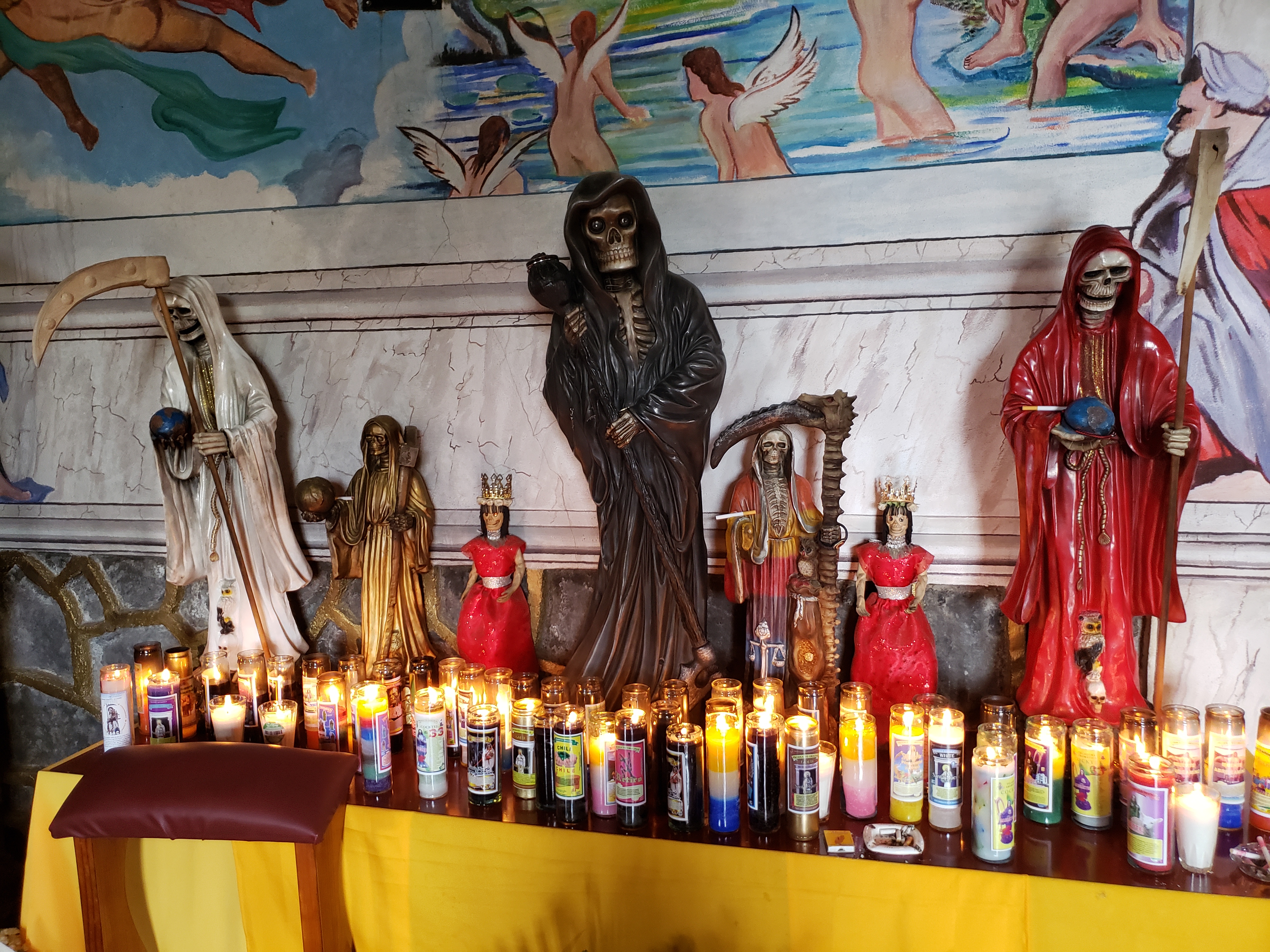
Colour symbolism is central to devotion and ritual. There are three main colors associated with Santa Muerte: red, white, and black, each one associated with a different Santa Muerte power. In the picture we see not only the red candle of love, passion and lust, with its label besprinkled with hearts, but also votives of colours that depart from the main trio. The 7 colours represent the Saint of Death’s 7 powers. These candles, we may surmise, have been placed by a devotee yearning for miracles on many fronts, and not just one.
DEVOTED TO DEATH
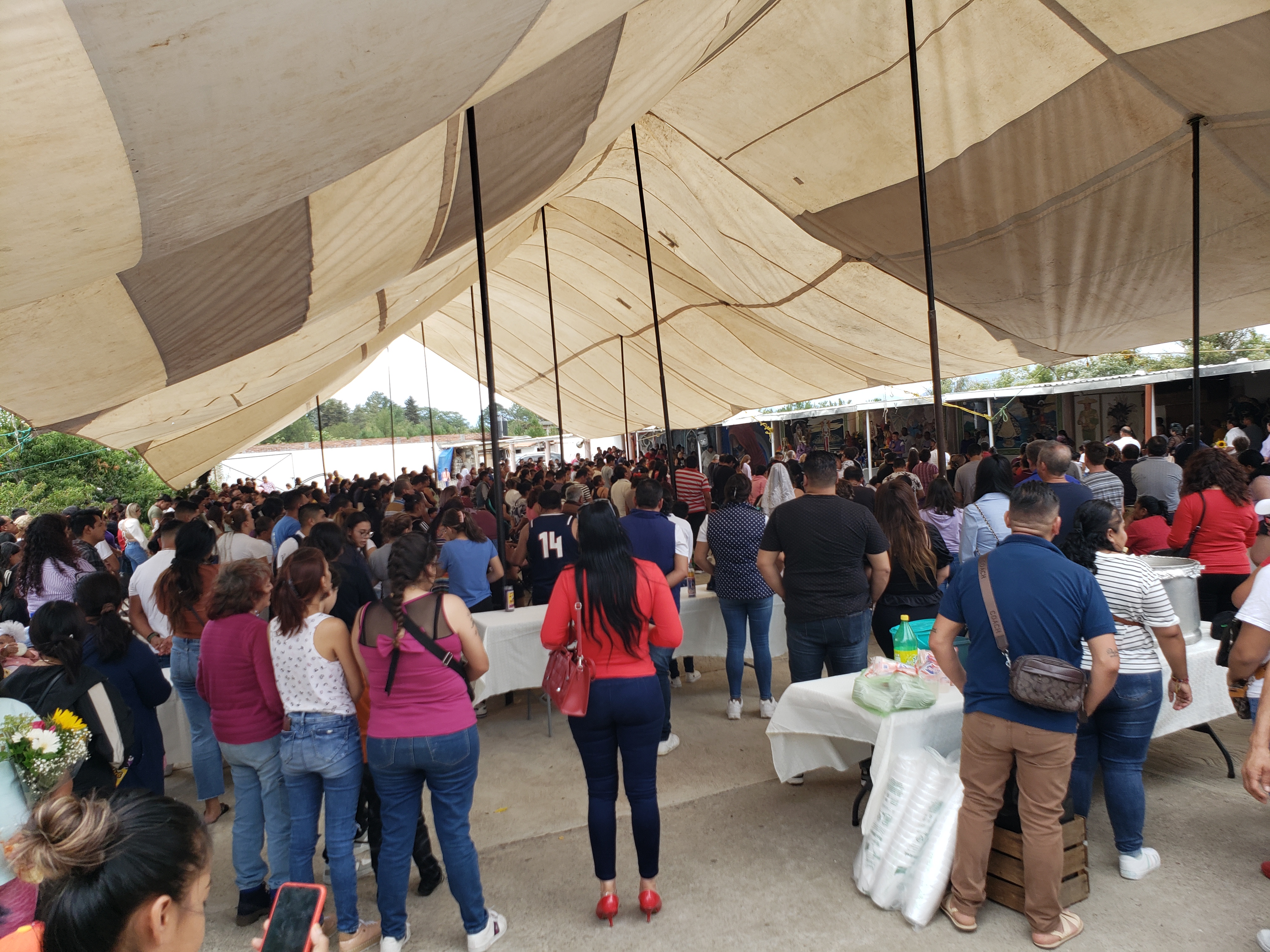
Chesnut visited during the monthly prayer service attended by some 300 devotees.
DEATH AS AN INDIGENOUS GODDESS
Kingsbury and Chesnut have demonstrated that devotees forge the folk saint of death in their own image, and this effigy is proof. We see that a devotee has crafted Santa Muerte in the image of an Indigenous Purepecha woman. Indeed this is what’s most unique at the Michoacan temple – the representation of Holy Death as a Purepecha Indigenous figure. Based in the nearby town of Tzintzuntzan, the Purepecha (also known as Tarascans) were an impressive Meso-American civilization that ruled the present day state of Michoacan and part of Jalisco. Most Michoacanos are very proud of their Purepecha heritage and are quick to point out that the neighboring mighty Aztec empire was never able to subdue them. The Purepecha deity Cuerauaperi presides over both birth and death, the latter especially in relation to experiencing a violent end, which has been all too frequent in Michoacan as an epicenter of the Mexican drug war.

WINGED REAPRESS
Santa Muerte in her advocation as the Angel of Death is seen throughout the temple.

DAY OF THE DEAD
The Lake Patzcuaro region, cradle of the Purepecha, is famous for its Day of the Dead commemorations which are depicted below.

SYNCRETIC DEATH
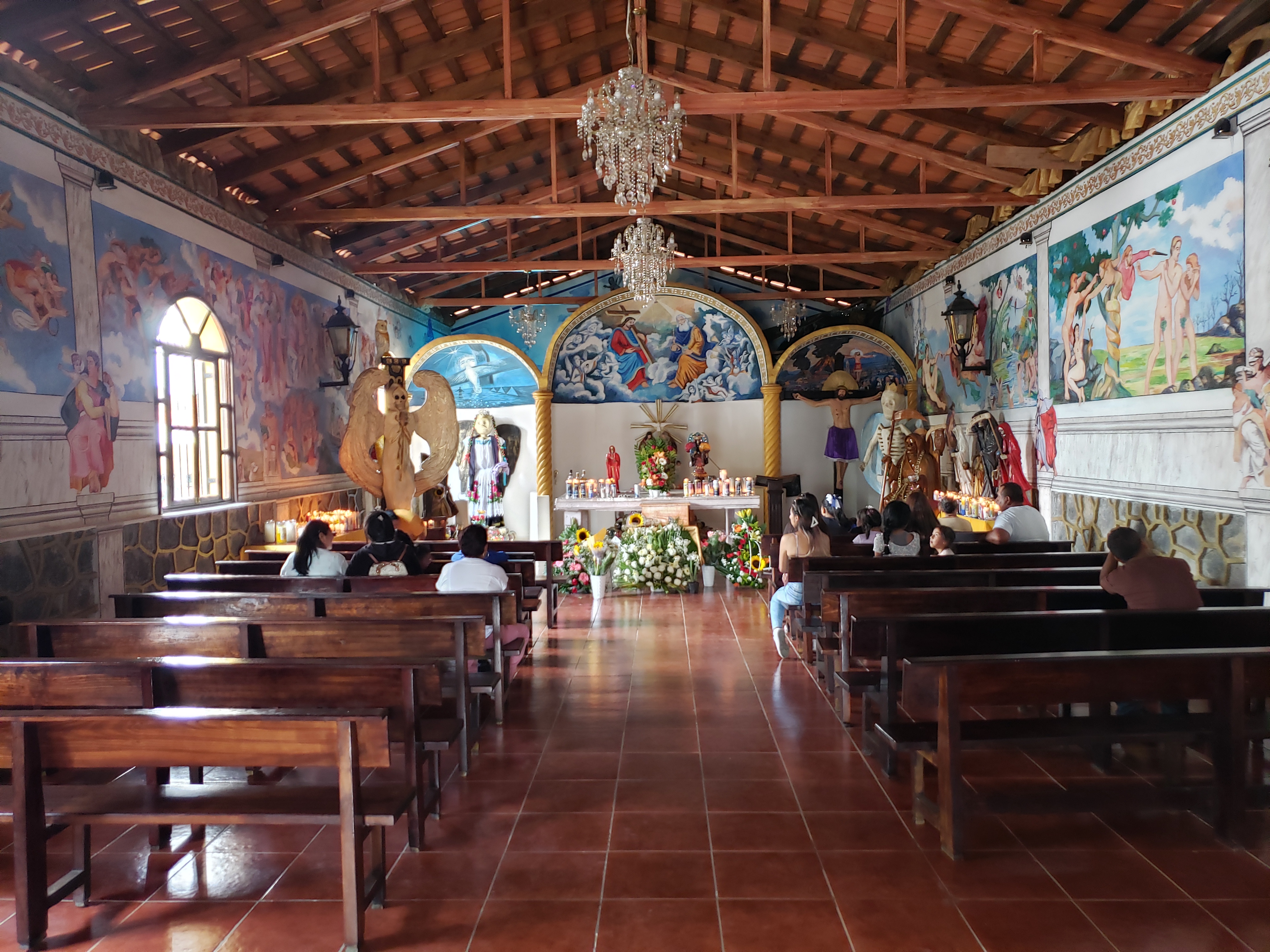
The sanctuary filled with images of both the Skeleton Saint and Christian figures underscores the Catholic influence and roots in the country with the world’s second largest Catholic population after Brazil.
OUTLIER ORISHA
Yemaya, the mother of all Orishas in Cuban Santeria and Brazilian Candomble, is an interesting outlier at a temple noticeably devoid of African Diasporic religious influence.

BOOK OF LIFE
The Queen of Death examining the Book of Life to see whose name is next to be crossed off.

DEATH IN DOLLARS
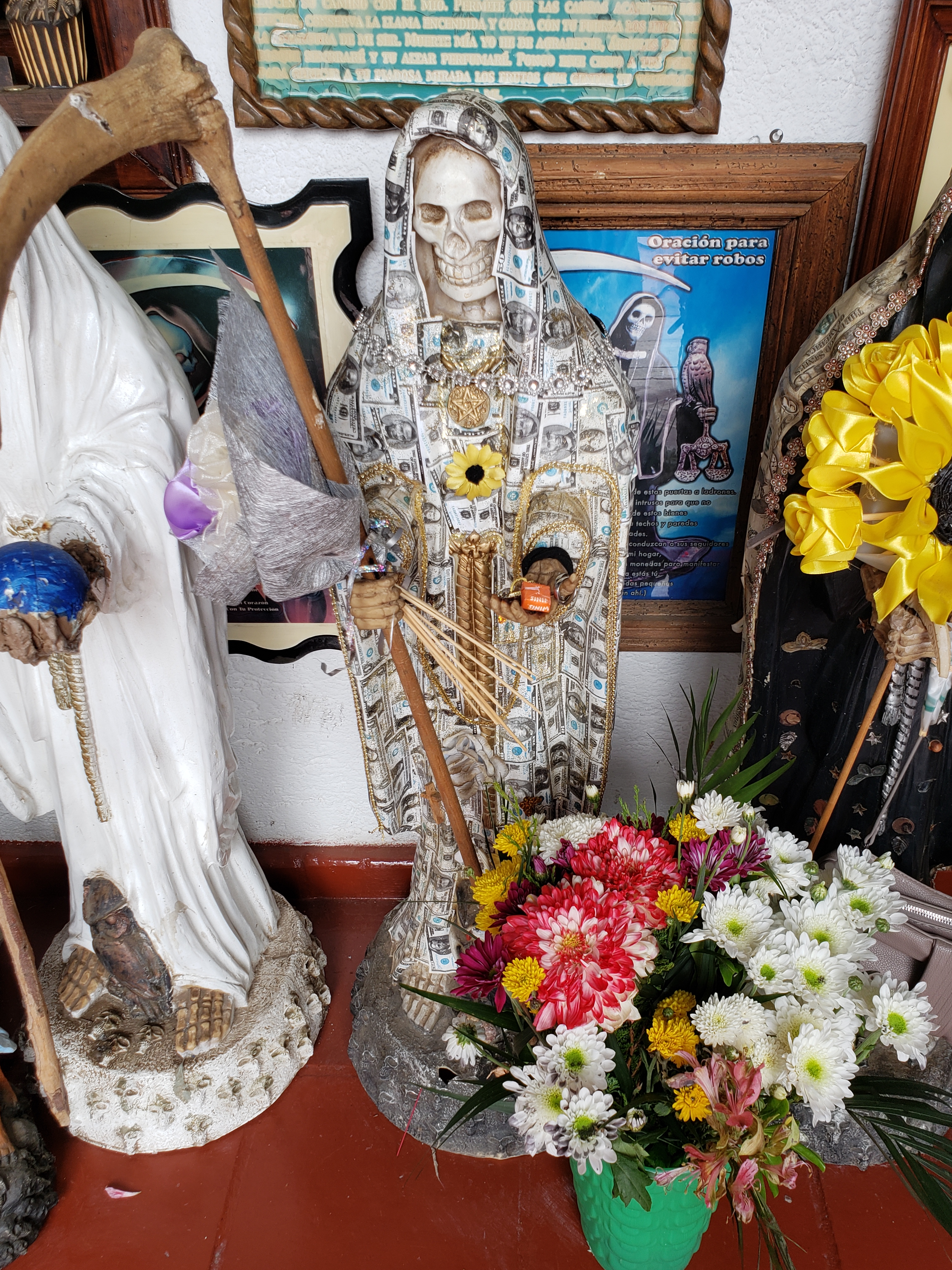
The Bony Lady always wears cloaks of US dollars instead of Mexican pesos because the US currency is stronger and millions of Mexican migrants living in the US remit billions of greenbacks to their families in Mexico annually.
MODERN MUERTE
With her coiffed locks and Day of the Dead face paint, the Lady in Blue below sports a more contemporary look. Santa Muerte was originally depicted as bald – in fact “la Pelona” or Bald Lady is one of her original monikers. These days she usually appears with long locks, be they jet black, platinum blond or shocking pink.

COLOUR PLAY
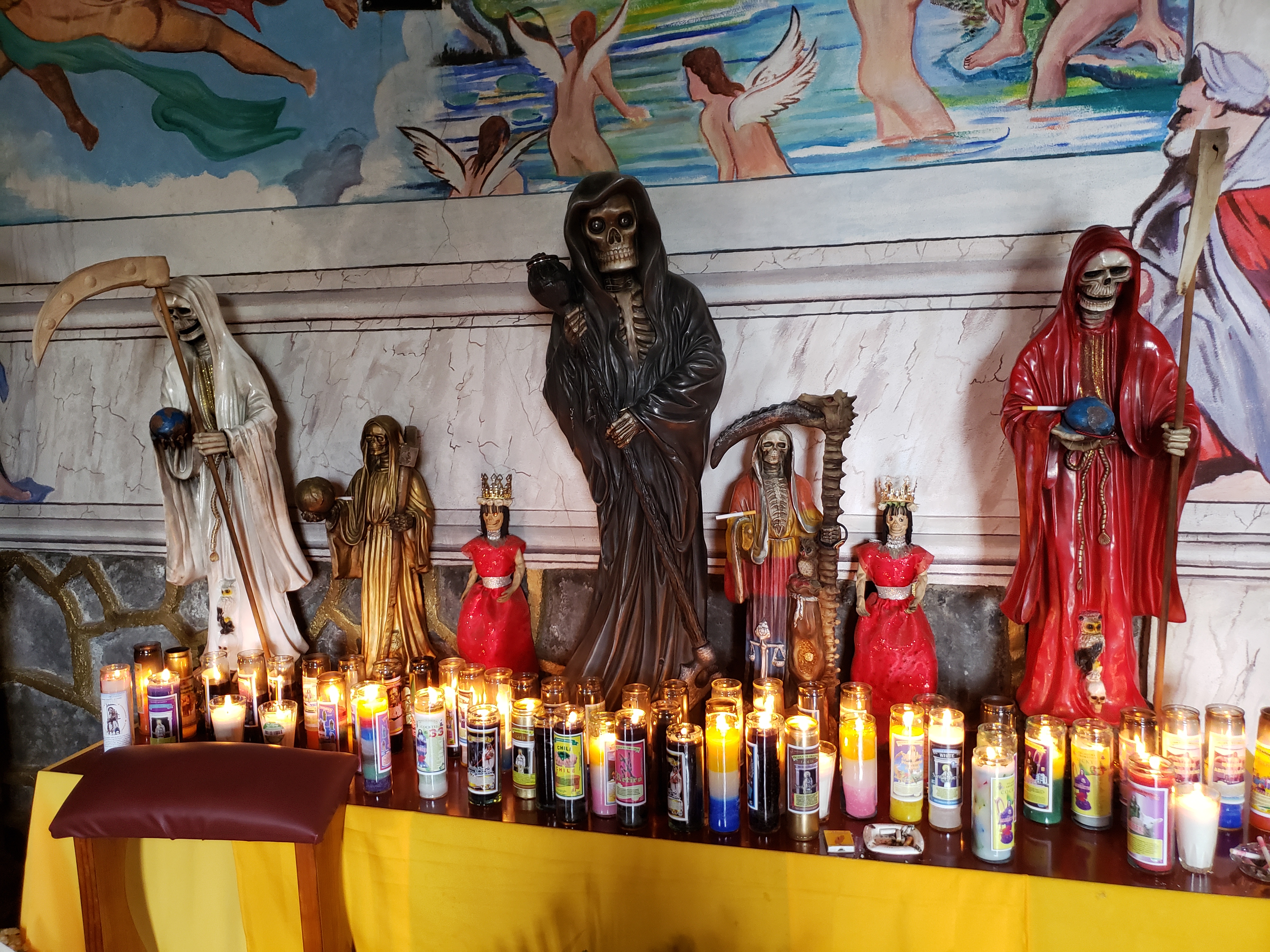
The black and white effigies below constitute two of the three original colors of the cult. Along with red for love and sex, ebony and ivory images accounted for all the depictions of the Skeleton Saint until the 1990s when she went polychrome.

PAPER MACHE PARCA
The scythe is one of the Grim Reapress’s most important accoutrements which in addition to symbolizing the reaping of souls, represents a weapon for both defensive and offensive purposes depending on the circumstances.

MATRON SAINT OF NIGHT CLUBS
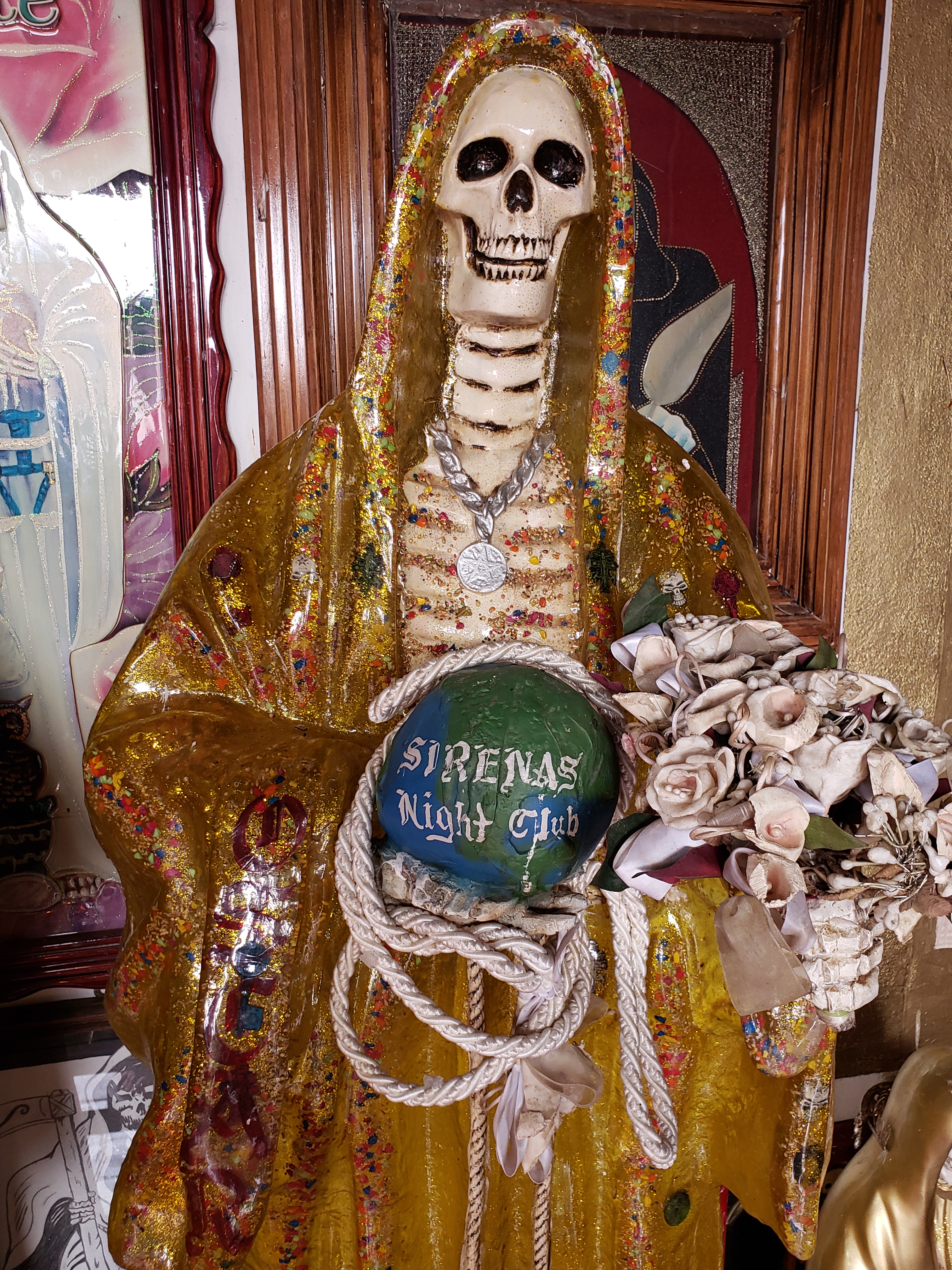
Not only is the Powerful Lady the matron saint of Sirenas Night Club, as seen below, but also of both Mexican sex workers and the clubs they frequent.
HISTORIC DEATH
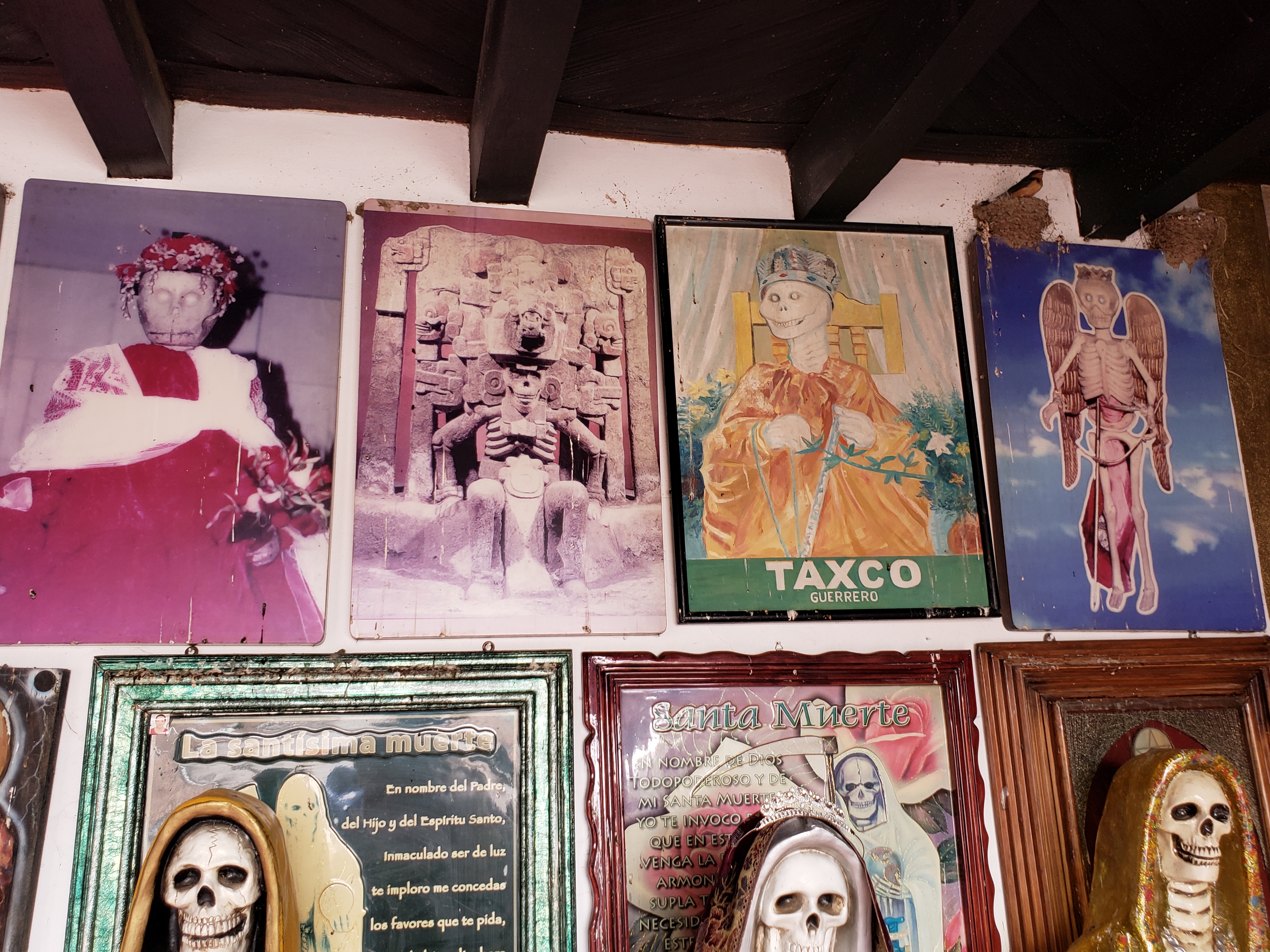
The posters below depict two of the oldest known effigies of Santa Muerte along with Aztec death god Mictlantecuhtli.
CAHOLIC DEATH
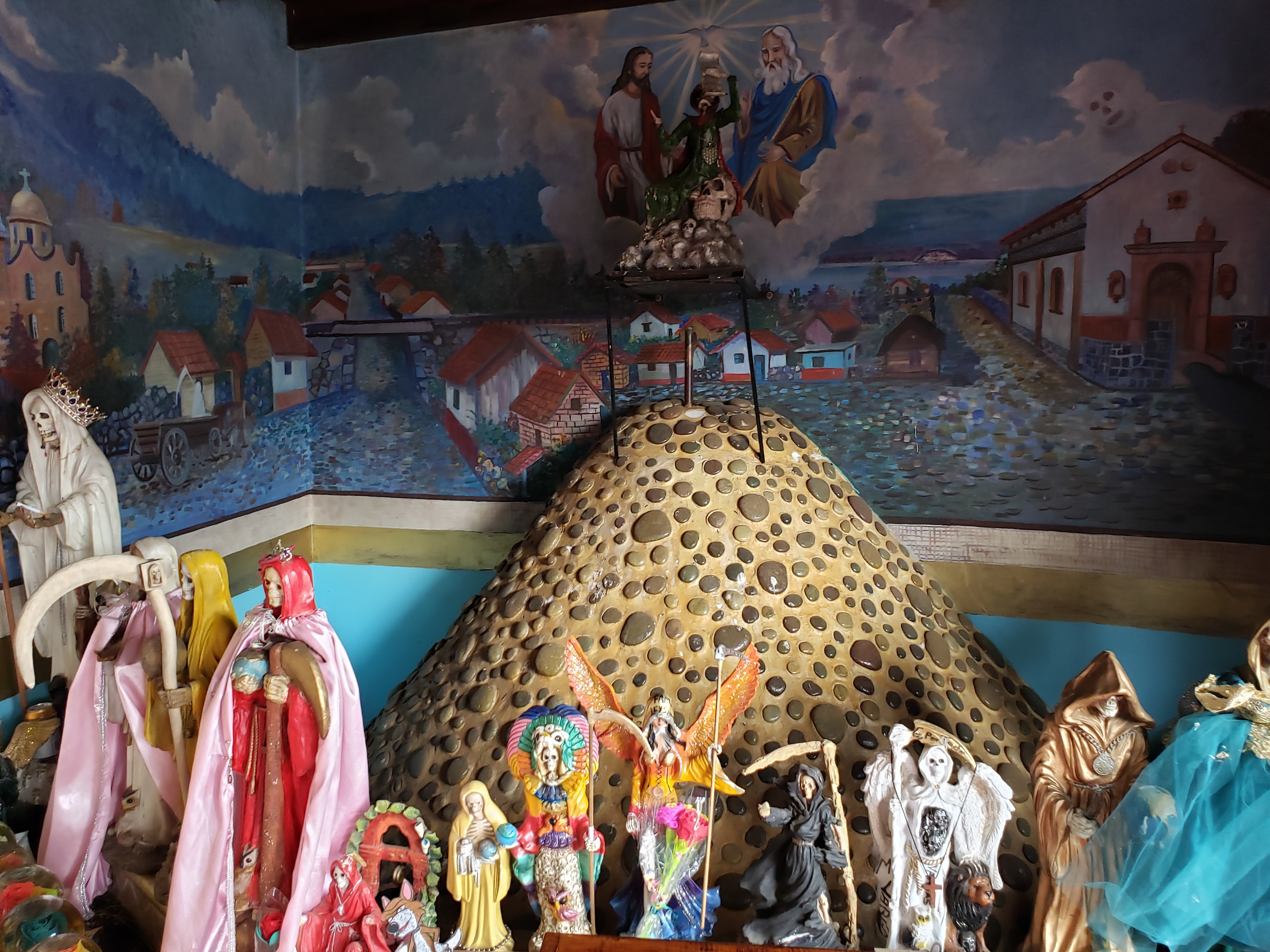
Despite the Church’s insistence that Santa Muerte is satanic and that her devotees are heretics most Mexican Santa Muerte devotees consider themselves Catholic. They see the folk saint as part of their Catholic tradition and thus meld imagery and iconography from official Catholicism with their devotional beliefs, praxis and aesthetics. As a result, many shrines and altars are crawling with Christian saints and imagery.
GOTH DEATH
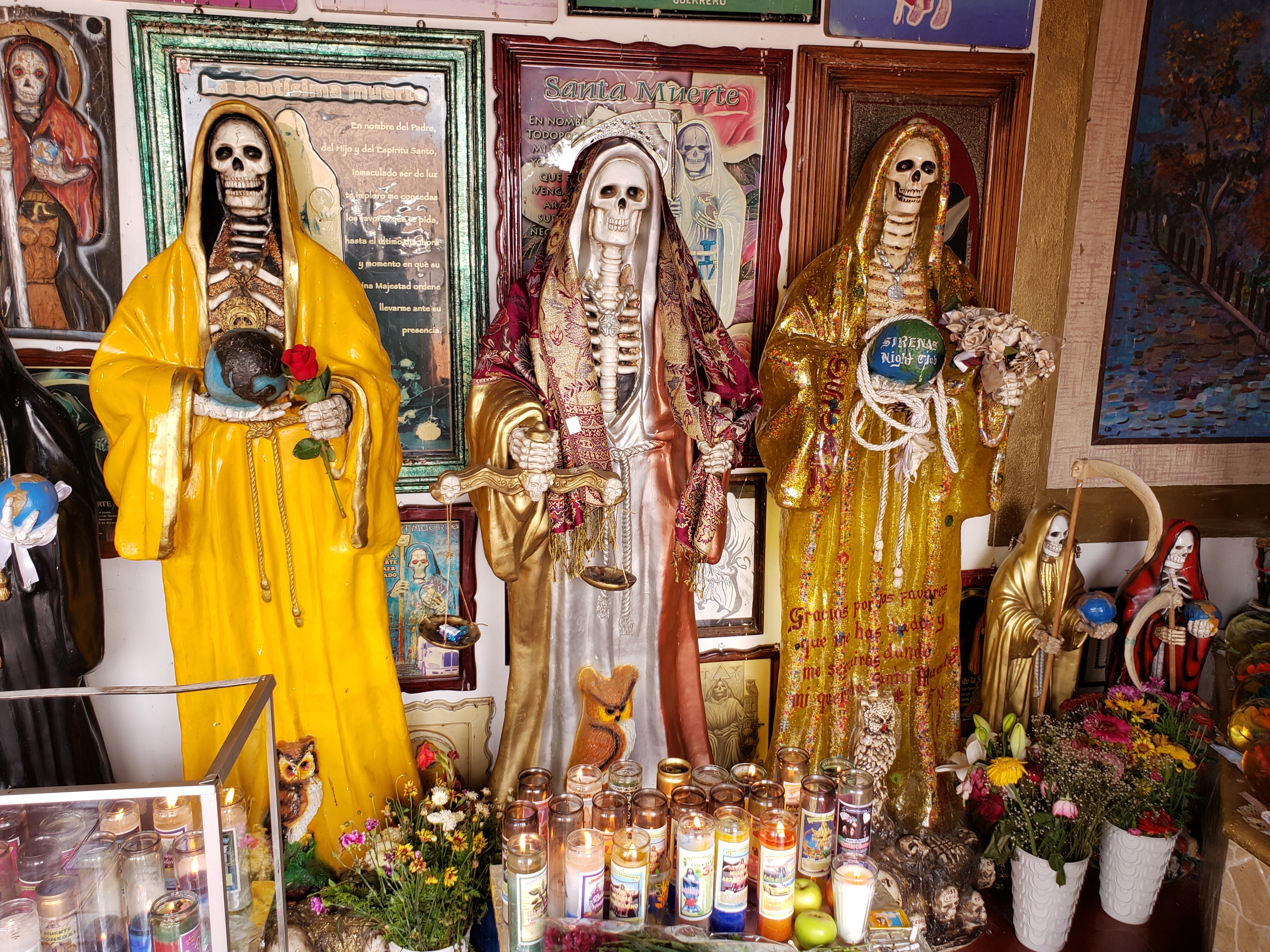
What catches the eye with these three life-size effigies is their European gothic aesthetic. Recalling that the Spanish colonial Church brought over the figure of the Grim Reapress, la Parca, who syncretized with Indigenous death deities, all the oldest iconography is thoroughly European although praxis is not.
THE GLOBAL DOMINION OF DEATH
So many of the images at the Michoacan temple depict the death saint either with planet earth in her hand or beneath her feet, which in this case are planted on Canada where Kingsbury lives. While she may have arisen from Mexico’s unique culture of death, Saint Death rules over the entire world.

FEMININE DEATH
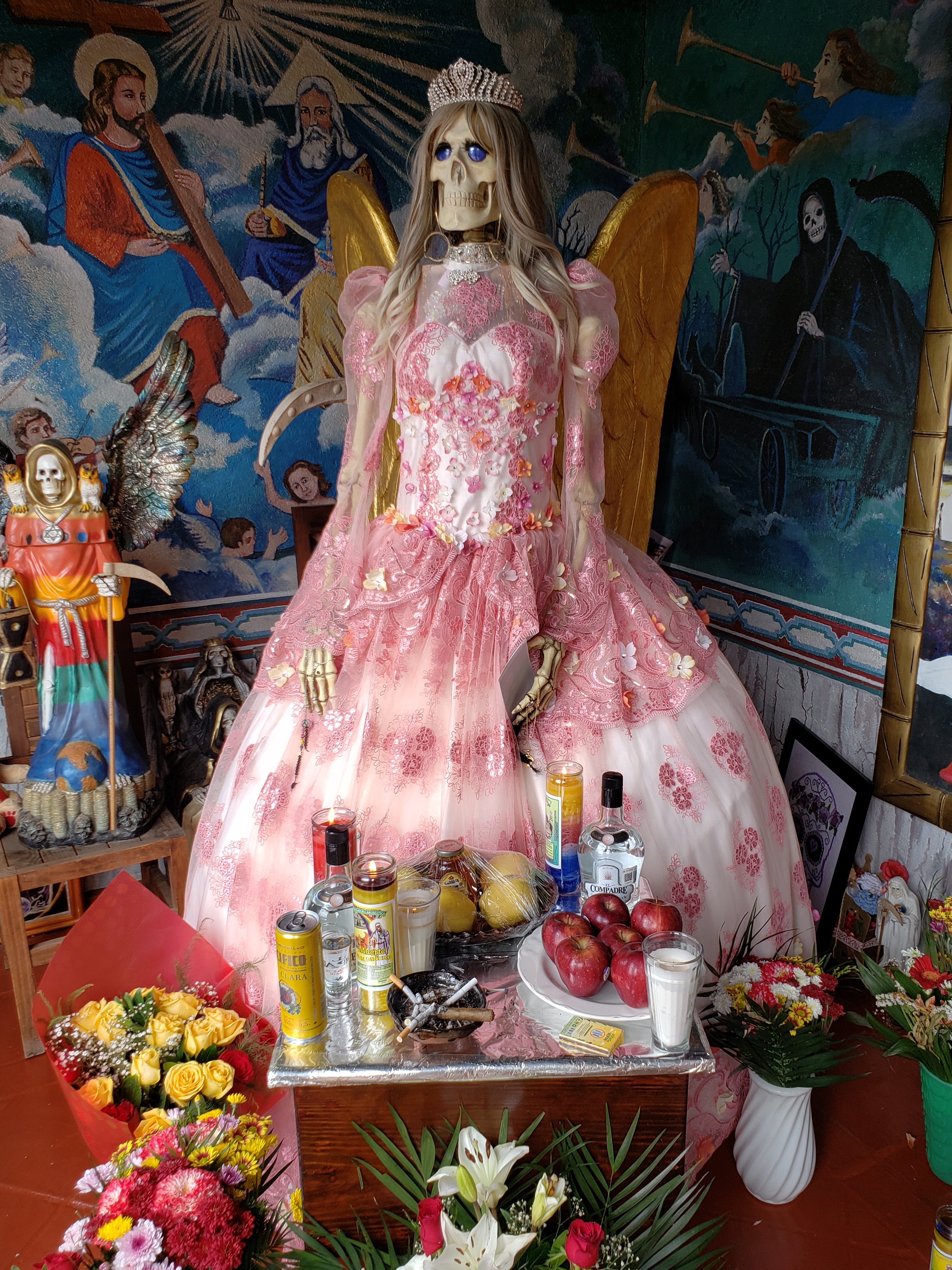
This statue underscores the ambiguity of Santa Muerte’s gender. While her skeletal form reveals no traces of femininity or masculinity, the saint’s gender is rendered tangible by devotees’ sartorial choices for the folk saint who create her femininity through fashion and corporeal styling. Here we see the saint of death in full female regalia, as what is likely a female devotee has adorned her in the accoutrements deemed desirable for a woman. Garbed as such, effigies give us insights into the cultural construction of femininity in Mexico from the visual standpoint. In this statue, this consists of a wig of long, lustrous locks, a lacey dress, ample jewelry and a purse as Americans say, or handbag for the British. Since Queen Death is considered supremely powerful, this effigy is also bedecked with a spangled tiara, signifying her sovereignty over life and death.

VOLCANIC DEATH
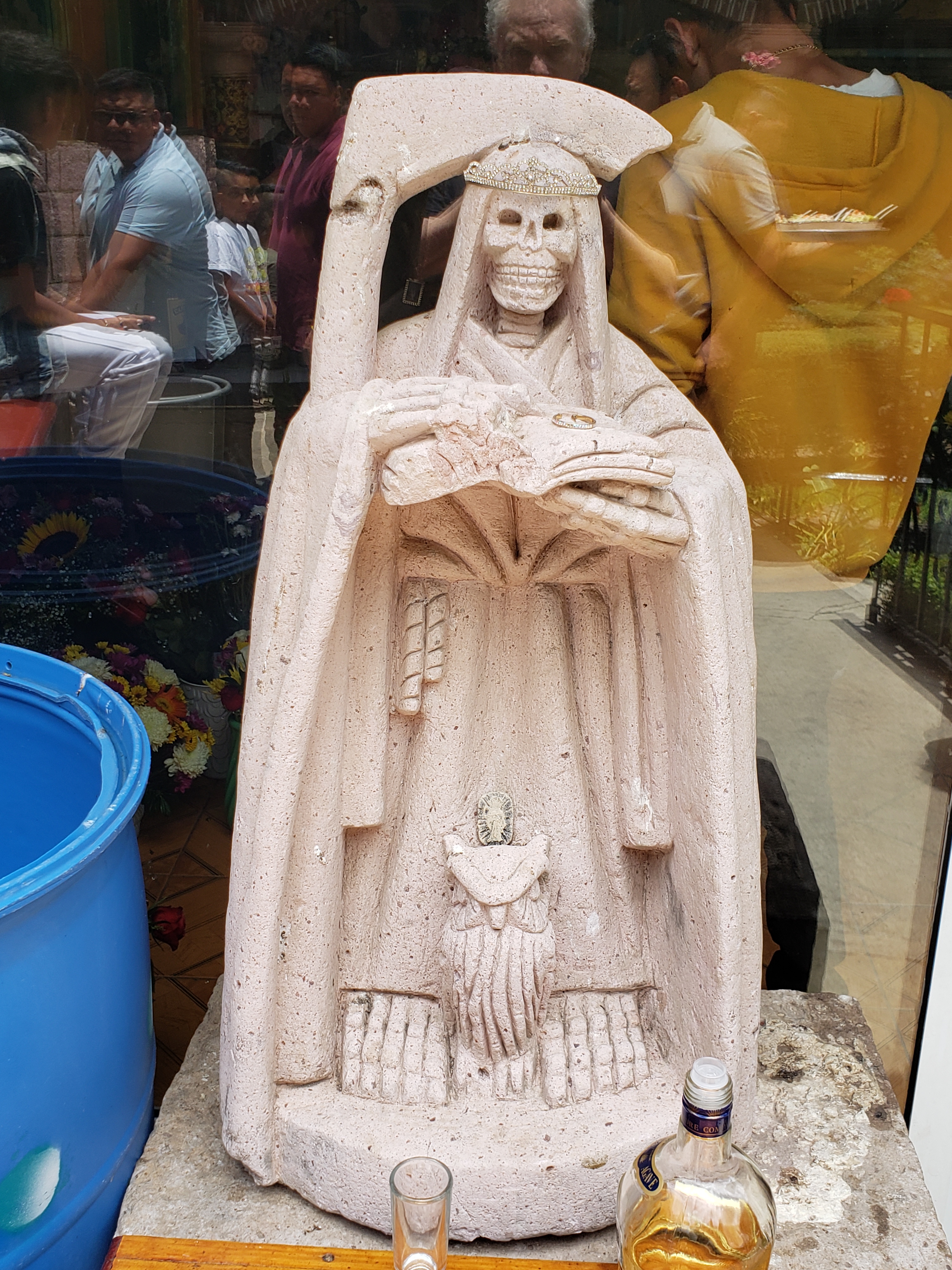
Another unique element of the imagery at the temple is the presence of statues carved from local pink volcanic rock known as “cantera rosa.” Most of them, such as the one below depict the Skeleton Saint in her original European Catholic garb.
SANTA AGUA
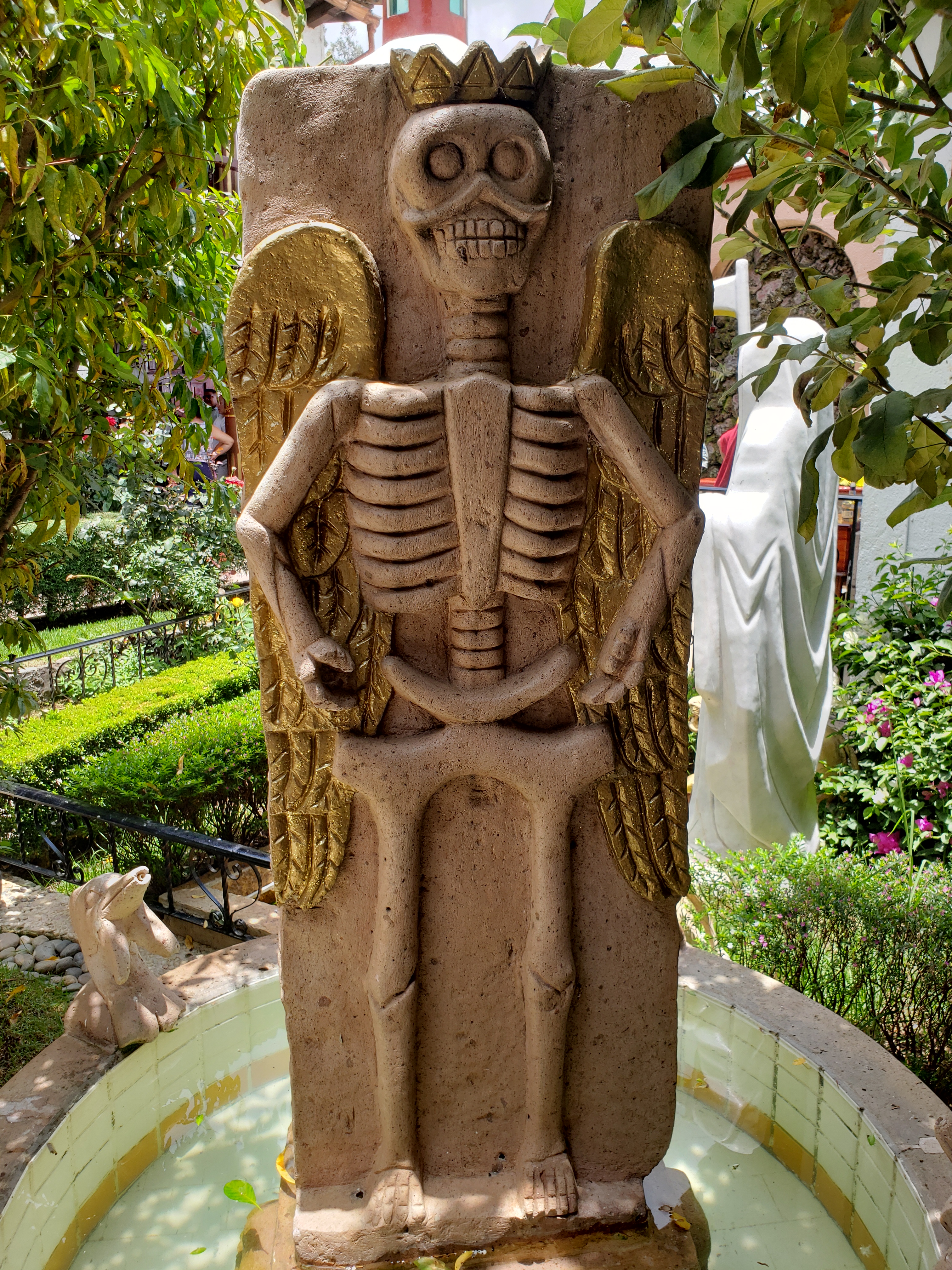
Whilst many devotees depict Santa Muerte as chthonic, in keeping with Indigenous notions of death, she is also depicted as an angel of death from the celestial realms and this winged statue speaks to that idea. Angels are notoriously asexual and this effigy is rather androgynous. It stands in a pool of water, which has much importance in the folk faith. As Chesnut has pointed out, in continuity with Christian ritual, water at the altar of the saint of death cleanses, purifies, and renews. Conversely, in Mexican traditions water can represent death. Many Mexicans, Argentines, and other Hispanophones interpret water in dreams as a sign of impending death. The water of their dreams isn’t a life-sustaining liquid but the stuff of nightmares in floods that drown and tides that rip
DEATH AS BRIDE
Another main advocation of the White Girl (one of her myriad monikers) is that of a skeleton bride and in this particular case waiting eternally for the perfect groom who never shows up. There are a number of variations on this theme, including temporary marriages to the deathly bride for male devotees. Albeit, while male devotees may insist Santa Muerte is their wife, when prompted female followers will assert that Sai Holy Death is beholden to no man.

QUEEN DEATH
With the golden corona atop her head and gilded skulls the statue below represents the Monarch of Death who has dominion over the earth and through her white robes offers purity and protection to believers as well as prosperity and abundance. The two lions at her side evoke both her ferocity and make allusions to symbology associated with European royalty, for she is Queen Death.


PUREPECHA GIRL
A portrait of the temple’s deceased founder who apparently retired from an unknown profession in Mexico City and decided to erect a grandiose monument to the object of his devotion in an area renowned for its death culture. Years ago a Santa Muerte shaman from Patzcaruo told Chesnut that the Bony Lady originated in the town of Santa Ana Chapatiro as a Purepecha girl and that her skeleton is hidden somewhere in the area.

INDIGENOUS DEATH
This Indigenous effigy of Santa Muerte interweaves not only key aspects of her European iconography but also her pre-Hispanic aspects, which as Kingsbury and Chesnut have pointed out, empower Indigenous practitioners in a country where traditional Christianity may be seen as far-removed from Indigenous realities. In this statue, the owl does double duty symbolising the saint’s wisdom as in Greek mythology, but also death as in Indigenous thanatology. A common Mexican expression is ‘when the owl screeches, the Indian dies’.
Although on Tarascan territory, her headdress is distinctly Aztec, resembling the featherwork designs worn by Mexica nobles. Aztec headdresses had a disc-type shape. This represented the sky and the cosmos, serving as a reminder of the oneness of self with these. Snakes are also a common motif in both Mayan, Aztec and Tarascan art. They are often associated with rebirth and renewal, as well as the celestial planes, which make them fitting in this Santa Muerte statue

ANGEL OF DEATH
One of Santa Muerte’s main advocations is as the Angel of Death who, like the Grim Reapress, comes for the souls of mortals at the appointed time. Donning a black nun’s robe and shawl with her bony hands clasped in prayer, the effigy below evokes the Catholic origins of Santa Muerte in Spain. Of the various offerings at her feet what stands out as singular is the dish of mole and rice, a signature Mexican dish. Food offerings typically consist of fruits and candies, less so cooked meals.

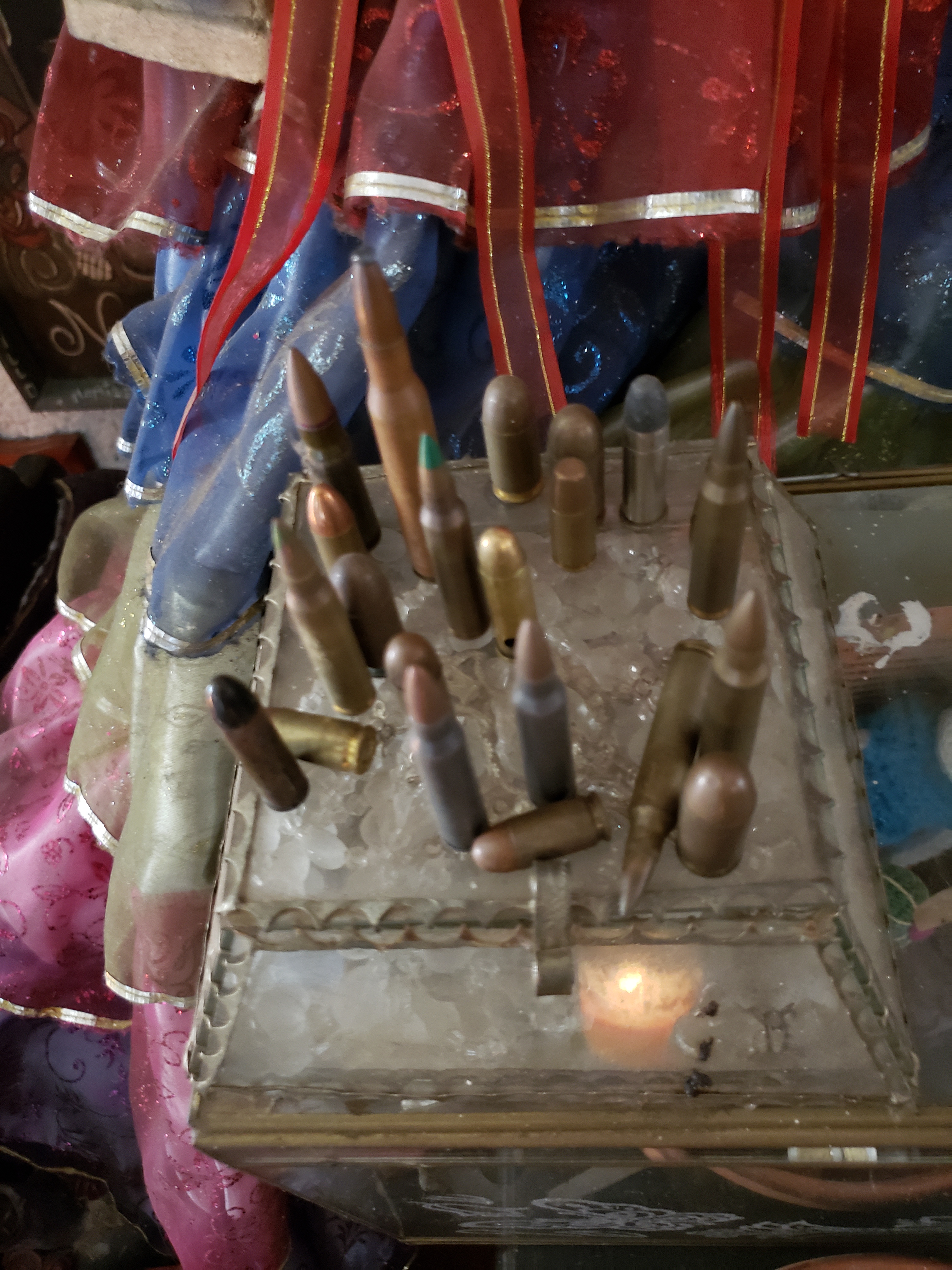
BLESSED BULLETS
The Lady of the Shadows is popular with both Mexican law enforcement and narcos and many of them ask her to bless their guns and bullets, especially in Michoacan which is one of the epicenters of drug production and trafficking.
DEATHLY SMOKES
Tobacco is an important offering in Santa Muerte devotion. Followers of the formidable folk saint may give puros (cigars), cigarettes or even marijuana-cigarettes. For thousands of years, tobacco has been an integral part of Indigenous culture across the Americas. Used in ritual, ceremony, and prayer, tobacco has long been considered a sacred plant with healing benefits and spiritual attributes

KING DEATH
This effigy once again sports highly masculine features and is stylised as “King Death”. Culturally death in pre-Columbian Mexico was typically associated with women. In Northern Europe, death was depicted as male, but in the Mediterranean it was female and the Spanish would bring with them feminine representations and ideologies of death when they first conquered the so-called New World, leading to the nascence of Santa Muerte from the Spanish female Grim Reaper “la Parca” with an admixture of pre-Hispanic death deities, such as the Aztec Goddess of the Underworld Mictecacihuatl, as we have detailed. The idea of “King Death” gained popularity in Spain in the early 1600s after the worst years of the the Black Death also known as the bubonic plague, wherein death made clear its triumph over life after millions died from the deadly disease. This idea would eventually travel to the New World and create several masculine skeleton saints such as Rey Pascual and San la Muerte.


*I obtained my doctorate in Anthropology from Oxford University, where I also acquired my MPhil. I am one of the world’s leading experts on Santa Muerte, one of the fastest growing new religious movements in the West. It is my life’s mission to record and document the stories of Santa Muerte devotees, in particular female devotees who I research. I am a pro bono board member of Uganda 4 Her uganda4her.org is a non profit organisation that aims to empower and educate girls in Africa, to ensure equal rights.

 Most Holy Death